d
Definition of forest landscape is the large-scale view of a forest. When industrial timber managers use the term “forest landscapes,” they are usually concerned with scenery and visual impacts. In the context of an ecosystem-based approach, however, a forest landscape is a mosaic of interconnected, interdependent stands or patches that are repeated in a pattern across the larger landscape. This pattern has both spatial and temporal components.
An ecosystem-based approach requires that all planning and activities begin at the regional/landscape level. When planning for human use, landscape level decisions are made for watersheds of small to moderate size (less than 5,000 hectares to about 50,000 hectares, or 12,000 to 125,000 acres). In sub-regional or regional planning processes, forest landscape level considerations are expanded to large watersheds encompassing hundreds of thousands of hectares/acres.
In planning and carrying out forest uses, particularly timber management, many people tend to focus on small forest parcels. This is a result of our limited spatial view, short time frames, and cultural conditioning. In contrast, an ecosystem-based approach requires that all planning and activities start at the landscape level. The character and condition of the forest landscape dictate what is ecologically possible at the stand level.
The character of a forest ecosystem refers to how a forest works, from the landscape level to the stand or patch. For example, forests that have frequent fires have a different character than forests where wind and root decay are the primary agents of disturbance. Some forests are characterized by steep slopes, shallow soils, and well-defined drainage patterns, while other forests have gentle slopes, cold soils, and diffuse drainage patterns.
Forests of a different character will have different composition and structures, and therefore differences in how they function. Different composition, structures, and functioning lead to different kinds of ecological limits to human use. Ecological limits are natural factors or processes that are easily damaged or degraded if modified by human uses. For example, steep and/or wet slopes impose ecological limits because, if disturbed, they are likely to erode, causing problems like soil loss and siltation of streams. Cold soils are an ecological limit because nutrient cycling occurs in shallow organic layers which may be easily damaged by many types of human activities.
The condition of a forest describes how human uses have modified forest functioning from the landscape level to the stand or patch level. Conventional timber management frequently results in negative impacts, like fragmentation, loss of old growth, and soil degradation. An ecosystem-based approach protects forest composition and structure and respects the ecological limits of forests to various human uses. By respecting ecological limits ecosystem-based approaches avoid degradation of short- and long-term forest functioning.
Ecological limits to human use are determined by describing and interpreting the character and condition of, first, the forest landscape, and then the forest stand or patch.
THE IMPACT OF THE HUMAN ACTIVITIES ON THE ECOSYSTEMS
The impact of human activities on the fundamental ecological process of the planet grows so to does the list of species and ecosystems at risk. Addressing the damage and loss requires that we understand the causes and take action based on that understanding. Underlying threats to biodiversity include the size and distribution of the human population, the level of resource consumption, programs and policies that effectively provide incentives for the depletion of biological diversity and failing to recognize the full value of environmental goods and services. While these underlying causes are often related to universal human values and are extremely complex and difficult to address, there are more direct and immediate threats that can and should be addressed at the provincial and local levels.
The immediate threats to biodiversity can be summarized under five main headings: - habitat loss and fragmentation,
- invasive exotic species,
- pesticides and pollution,
- over-harvesting and
- global warming.
The next most serious problem is invasive exotic species. Hundreds of species have been deliberately or accidentally introduced and some have become serious threats to native species. For example, leafy spurge can completely displace native vegetation, European carp destroy the habitat of other fish and non-native ladybugs may out-compete their native counterparts. Many of these non-native species are also serious agricultural pests responsible for millions of dollars in lost revenue.
The widespread use of pesticides also poses a threat to the biodiversity. Herbicides and insecticides can kill beneficial native plants and insects. Improperly used pesticides also promote the evolution of resistance in pests, which can also reduce the long-term effectiveness of the pesticides. The combined impact of the increasing number of exotic pests and the need to control all pests highlights the need to develop more ecologically friendly and sustainable pest management tools.
Climate change is acting in concert with the other forces to increase the impacts on native species. For example, species' ranges expand or contract as an adaptive response to natural climate variation. As global warming continues this requirement for range movement will likely increase. However, movement of species is very difficult due to extensive habitat loss and fragmentation. It is therefore vital to re-establish or maintain linkages or corridors across ecosystems that will allow for the movement of these species and their genes.
DEFINITION GYMNOSPERM
Gymnosperm, is the name of one of two large groups of seed plants. The plants have naked, or uncovered, seeds. The term gymnosperm comes from two Greek words meaning naked and seed. The other group, called the angiosperms, consists of plants whose seeds have a protective ovary (seed case).
The gymnosperms are a group of seed-producing plants that includes conifers, cycads, Ginkgo, and Gnetales. The term "gymnosperm" comes from the Greek word gymnospermos (γυμνόσπερμος), meaning "naked seeds", after the unenclosed condition of their seeds (called ovules in their unfertilized state). Their naked condition stands in contrast to the seeds and ovules of flowering plants (angiosperms), which are enclosed within an ovary. Gymnosperm seeds develop either on the surface of scales or leaves, often modified to form cones, or at the end of short stalks as in (Ginkgo).
The gymnosperms and angiosperms together compose the spermatophytes or seed plants. By far the largest group of living gymnosperms is the conifers (pines, cypresses, and relatives), followed by cycads, Gnetophytes (Gnetophyta, Ephedra and Welwitschia), and Ginkgo (a single living species).
Gymnosperms are vascular seed plants that display very prominent and large bodies, mainly in evergreen tree form. During the ancient past gymnosperms dominated the landscape with their size and abundance. However, in modern times, gymnosperms are represented by less than one thousand species.
The Structure of Gymnosperm Types
Coniferophyta (Conifers) The basic body plan of conifer is that of an evergreen tree. Evergreen in the fact that most of these trees do not drop all their leaves (or in this case, needles) at once in the fall and grow them all back at once in the spring as do deciduous trees. Larches and bald cypress trees are an exception, however.
Gymnosperms are woody perennials which are among the largest and oldest living plants. There are about 800 species of gymnosperms. About 600 are conifers such as the pines, firs, spruces, and balsams. These cone-bearing trees make up the largest division (group) of gymnosperms. The tropical and subtropical cycads, also gymnosperms, are among the most primitive living seed plants. The ginkgo, also called the maidenhair tree, is another primitive gymnosperm.
Many of the gymnosperms are evergreen with a wide variety in the structure of the leaves. They do not bear flowers. Tiny male cones produce the pollen, which is usually spread by the wind. The naked, or exposed, seeds are borne between the scales of the female cones and drop when they become ripe. Gymnosperms provide the source of many valuable products such as tar, turpentine, rosin, and timber.
DEFINITION OF CONIFER - CONIFEROUS FOREST
Conifers are one of the oldest groups of woody plants. Conifer fossils have been found in rocks that are about 300 million years old. Conifers include the largest, tallest, and oldest living things. The largest giant sequoia is about 275 feet (83.8 meters) high, and the base of its trunk has a circumference of 103 feet (31.4 meters). Redwoods, the tallest living trees, may tower more than 360 feet (110 meters) high. Some bristlecone pines are more than 4,600 years old.
Conifers form about 30 per cent of the world's forests. In North America, most of the wood used in houses and other buildings comes from conifers, especially Douglas-fir and loblolly pine. Conifers also provide much wood pulp for making paper and cardboard. In addition, millions of conifers are used every year as Christmas trees.
In southern Canada the Taiga mingles with the temperate deciduous forest in some places. In northern Canada, the Taiga gradually tapers off, and the Arctic Tundra begins. The Siberian Taiga in Russia and Asia often has taller trees.
The main feature of the northern temperate zone of Asia is the presence and great importance of conifer species. Their distribution is generally restricted to the temperate zone, while summer-green broadleaved species are dominant over the whole territory. Because of high fire sensitivity, the nemoral conifers can easily disappear from the communities leaving a great question for researchers; whether the pure broadleaved forests in densely populated and severely deforested regions were originally summer-green broadleaved or whether they used to be mixed with conifers before human influence. Conifer forests in those regions occur in very small areas, as a rule – not comparable in size with the areas of broadleaved forests.
On the other hand, many conifer species are adapted to extreme edaphic conditions within the temperate zone, such as water deficit, wind exposure, nutritionally poor soils, slope processes and others.
Coniferous Forest
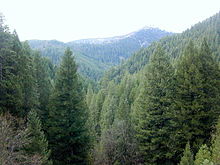
The Coniferous forest, located along the northern California coast, contains the largest life-form on Earth! The giant Sequoia trees are also the longest-lived life form on Earth. Some of these trees are 3,000 years old and counting!. Some coniferous trees depend on fire as a catalyst for seed-release. The Lodgepole Pine tree is an example of this kind of tree. The seeds develop in the pinecones, but unlike other conifers whose pinecones ripen and open to release the seeds, the Lodgepole's cones never ripen. The heat from naturally occurring fires force the Lodgepole Pine tree's serotinous cones to burst open, thus releasing the tree's seeds.
Temperature
-40°C to 20°C, average summer temperature is 10°CPrecipitation
300 to 900 millimeters of rain per yearVegetation
Coniferous-evergreen trees (trees that produce cones and needles; some needles remain on the trees all year long)Location
Canada, Europe, Asia, and the United StatesOther
Coniferous forest regions have cold, long, snowy winters, and warm, humid summers; well-defined seasons, at least four to six frost-free monthsMost conifers are evergreen and have small, needlelike leaves. Other conifers, including redcedars and cypresses, have tiny, scalelike leaves that cling to the stem. These trees are also evergreen. Larches and baldcypresses are conifers but they lose their leaves every year.
Conifer cones range from less than 1/2 inch (1.3 centimeters) long to more than 2 feet (61 centimeters) long. Conifers have two types of cones--male and female. In most conifers, both types grow on the same plant. The soft male cones produce and release pollen, then shrivel and die. The female cones are larger and become woody with age. Each of their scales has two structures called ovules, which contain eggs (female reproductive cells). Wind carries pollen from the male cones to the female cones, where the pollen fertilizes the egg. The ovules then develop into seeds. After the seeds become fully formed, they fall from the cones.
A few conifers have unusual, fleshy cones. Juniper seed cones resemble blueberries. Yew seed cones look like red berries with a single, large seed.
BROADLEAF FORESTS
Broadleaf forests grow in regions that have a fairly long growing season and plentiful rainfall. Every continent except Antarctica has broadleaf forests, which are also called hardwood forests. In areas with cold, snowy winters, almost all the trees in broadleaf forests lose their leaves each autumn. In tropical areas, most broadleaf trees are evergreen.
Before the 1800's, broadleaf forests covered much of the Eastern United States. They included such trees as ashes, birches, maples, and oaks. During the 1800's, most of the trees in these forests were cut down to provide lumber and fuel and to make room for farms and cities. Today, only a few parts of the Eastern United States have large broadleaf forests. Western Europe also had great forests of broadleaf trees, including ashes, beeches, and oaks. But most of these forests have been cut down.
Broadleaf forests that consist largely of quaking aspens and balsam poplars cover parts of southern Canada and large areas of southern Siberia. Forests of birches and oaks grow in eastern Europe and along the Yellow Sea coast of China and Korea. Southeastern Australia has valuable forests of eucalyptus trees. These broadleaf trees grow nearly as tall as California's needleleaf giants, the redwoods. Some eucalyptus trees stand more than 300 feet (91 meters) tall. About 600 kinds of eucalyptus trees grow in Australia. Almost all of these trees are evergreen. In many areas, mixed forests of broadleaf and needleleaf trees grow alongside broadleaf or needleleaf forests. Central Canada, the Eastern United States, central and southern Europe, and eastern Asia all have large mixed forests.
Remarkable broadleaf forests grow in tropical regions where the weather is always hot and rain falls regularly every month of the year. In these tropical rain forests, many of the trees look alike. They are tall, and many tower more than 150 feet (46 meters). The trees have leathery, dark-green leaves. Because the trees receive plenty of moisture throughout the year, most of them are evergreen. The trees may thus look alike, but they belong to many species. Many palms grow among the broadleaf trees in the tropical rain forests. The largest rain forests are in South and Central America, central Africa, and Southeast Asia.
NEEDLELEAF FORESTS
Needleleaf forests grow mainly in regions that have long, cold winters. These forests, which are also called softwood forests, stretch across Canada, northern Europe, and Siberia. Many firs, larches, and spruces grow in these northern forests, along with a few broadleaf trees, such as birches and willows. Some willows grow even farther north than needleleaf trees do. But they seldom reach more than shrub size. Needleleaf forests also blanket slopes in such mountain ranges as the Alps and the Rocky Mountains.
The Canadian needleleaf forests extend southward into the Western United States, where they include many of the world's largest trees. Many California redwoods tower over 300 feet (91 meters). Tall Douglas-firs also grow in the Western United States. A few needleleaf forests grow in warmer regions. For example, the Southeastern United States has large forests of pines, such as loblolly pines and longleaf pines. These forests provide great quantities of wood for lumber and wood pulp.
NEEDLELEAF TRESS ARE ABOUT 500 SPECIES
Needleleaf trees include such familiar trees as firs, hemlocks, pines, redwoods, and spruces. There are about 500 species of needleleaf trees. Most of these trees have narrow, pointed, needlelike leaves. But a few types, such as cedars and junipers, have narrow, scalelike leaves.
Most needleleaf trees are evergreen, though they produce new needles each year. The oldest needles turn yellow or brown and drop, but the youngest needles remain green and do not fall. A few species of needleleaf trees are deciduous. One kind is the larch, which grows in northern forests throughout the world. Another deciduous needleleaf tree is the baldcypress that grows in swamps of the Southeastern United States.
Foresters call needleleaf trees softwoods because most of them have softer wood than broadleaf trees have. But the wood of Douglas-firs, yews, and some other needleleaf trees is hard.
Needleleaf trees belong to a group of plants called gymnosperms. Gymnosperms do not have flowers and their seeds are not enclosed to form fruits. Most gymnosperm trees bear their seeds in cones composed of hard scales. The seeds lie open on the surface of the scales. Botanists call such trees conifers.
Most conifers grow north of the equator. The conifers belong to four families-the pine, yew, cypress, and taxodium families. The pine family is by far the largest. It includes not only pines, but also such trees as firs, hemlocks, larches, and spruces. Pine trees make up a large genus (group of species) within the pine family. Loblolly pines, ponderosa pines, and white pines are a few North American members of this genus. The yew family includes such well-known ornamental trees as English yews and Japanese yews. Although yews are classified as conifers, they do not produce cones but cup-shaped "berries." Many members of the cypress family, such as arborvitae and junipers, have scalelike leaves and give off a spicy fragrance. The taxodium family includes baldcypresses and the largest of all living trees-the redwoods and giant sequoias.
Two conifer families-the podocarpus family and the araucaria family--grow mainly south of the equator. Podocarpus trees are tall evergreens with broader leaves than those of most needleleaf trees. The araucaria family includes the Chile pine. This strange-looking tree has snakelike branches covered with sharp, scaly leaves. It is sometimes called the monkey puzzle tree because its sharp leaves make it difficult to climb.
Subscribe to:
Posts (Atom)
Entri Populer
-
Amazon forest is one of the world's tropical forests in the Americas. Amazon Tropical Rainforest is the largest tropical forest in the ...
-
Definition of Forest Stands or Forest Patches refer to the ecosystem scale at which a relatively homogenous forest unit can be identifi...
-
Gymnosperm, is the name of one of two large groups of seed plants. The plants have naked, or uncovered, seeds. The term gymnosperm come...
-
MYCORRHIZAL SYMBIOSIS DEFINITION The terms symbiotic and mutualistic have been used interchangeably to describe mycorrhizal associati...
-
A population is a group of the same species that lives in an area at the same time. For example, all the moose on Isle Royale make up a popu...
-
All birds have feathers, and they are the only living animals that have them. When people think of birds, they usually think first of their ...
-
The chief job of leaves is to make food for plants. This food-making activity, called photosynthesis, occurs mostly in fully grown lea...
-
Each of the more than 260,000 species of plants differs from every other species in one or more ways. However, plants also have many fe...
-
d Definition of forest landscape is the large-scale view of a forest. When industrial timber managers use the term “forest landscapes,” th...
-
Needleleaf forests grow mainly in regions that have long, cold winters. These forests, which are also called softwood forests, stretch acr...