Showing posts with label coniferous forest. Show all posts

BALANCE OF NATURE


Plants, animals, and other organisms that live together in the same area-such as a forest or a pond-form a community. Within a community, the members of one species make up a population. The size of each population stays fairly stable unless some change alters conditions in the community. Biologists refer to the relative stability of each population within a community as the balance of nature.


Maintaining the balance

All living things are closely related to their environment. Any change in one part of nature-for example, a natural increase or decrease in a population of any species of animal or plant-causes reactions in several other parts. In most cases, these reactions work to restore the balance of nature.

Ecosystems. An ecosystem consists of the biological and physical environments of an area. The biological environment is made up of all living things in the community. The physical environment includes air, soil, water, and weather. All these biological and physical factors interact within an ecosystem. They compose a network of complex relationships that control population growth.

Each organism is related to a variety of the biological and physical factors of its ecosystem. For example, rabbits need air and water from the physical environment to breathe and drink. They also need biological features, such as plants, for food and cover  (shelter). On the other hand, rabbits are eaten by foxes and other predators (flesh-eating animals). In addition, several kinds of parasites live in and on rabbits.

The relationship among rabbits, plants, and foxes can be shown by an example of an ecosystem that includes these three organisms. Assume that during a certain year, the temperature and rainfall within this ecosystem are ideal for plant growth. As a result, rabbits have a more plentiful supply of food than usual. The female rabbits are well-fed and healthy, and most of them produce large litters. The young rabbits have enough food, and nearly all of them survive. In time, the area becomes overpopulated with rabbits, and they continually compete with one another for food and cover. The losers become weak and unprotected, and they may fall victim to disease and parasites. They also become easy targets for foxes, and so the rabbit population decreases.

More rabbits means more food for foxes. The foxes respond in much the same way as the rabbits did to an increased food supply-their population grows. But more foxes means that even more rabbits are hunted, and so the number of rabbits shrinks even further. The rabbit population will continue to decrease until it again comes into balance with the ecosystem's ability to support it-an ability known as the ecosystem's carrying capacity. Similar controls govern plant populations. On a small scale, such actions and reactions go on every day.

Competition plays a major role in controlling population growth. An ecosystem has limited amounts of the food and cover necessary for each population. Therefore, individual members of the same population must compete for those necessities. But competition is much less intense between different populations. For example, deer and rabbits are herbivores (plant-eating animals), but they usually eat different kinds of plants.

Competition for food. If a population becomes too large for the available supply of food, many of the weaker members will starve. Others may migrate into another ecosystem, but they may not survive. Still others, weakened by hunger, may die from disease and parasites, or they may be killed by predators.

Competition for cover. Competition for cover. Cover is a requirement for most populations. Only a certain number of rabbits can live in a given brier patch, and only so many foxes can occupy the available den sites. If the rabbit population becomes too large for the brier patch, competition will force some individuals to live in poorer cover. There, they will be more likely to be attacked by predators or by disease and parasites.

Predators can help maintain the quality of their prey population if the two species have lived for a long time in the same ecosystem. Under such conditions, the prey species learns to deal with the predators. Therefore, predators normally kill only the weakest and least desirable members of the prey population. The prey population thus stays in a healthy state.

Disease and parasites can reduce or even wipe out a population. But most pathogens (diseases and parasites) have been present throughout history. Most host (infected) species have become adapted to living with their pathogens. Disease and parasites serve as important population controls primarily in the presence of other factors, such as competition for food or cover.

Behavior helps govern the size of some animal populations. Three behavioral factors may be important: (1) territoriality, (2) dominance hierarchy, and (3) stress.

Territoriality occurs among animals that require a certain minimum amount of space, regardless of the available food and cover. Among such species, one animal or a group of animals establishes a territory. No other members of the species are allowed in this area, and breeding is usually restricted to the animals with territories. Such behavior ensures that the strongest members of the population-the animals with territories-survive and produce offspring.

Dominance hierarchies, often called "pecking orders," occur among many types of social animals. Within populations of such animals, the stronger individuals dominate the weaker ones. These dominant animals get the best food, cover, and breeding places. Weaker individuals are forced into areas with poorer food and cover, and some do not survive. The offspring of dominant parents also have the best chance to survive. The traits of the strongest individuals thus are passed on to the next generation of the species.

Stress occurs among crowded populations of animals. Stressed animals become aggressive and irritable, and they often fight with one another. Some individuals do not breed, and those that do breed produce small litters. Many females do not take care of their young. Diseases and parasites spread rapidly among crowded animals, further reducing their number.


Upsetting the balance

Natural factors and human factors may alter the relationships within an ecosystem. Earthquakes, floods, and fires started by lightning are natural factors that may upset nature's balance. Human factors that may do so include logging and livestock grazing. As a result of these and other factors, entire populations may be wiped out or may grow suddenly at an astounding rate.

A historical example illustrates a change in balance. During the early 1900's, a stable population of about 4,000 mule deer lived on the Kaibab Plateau in northwestern Arizona. Beginning in 1907, human hunters began killing the deer's natural predators-coyotes, mountain lions, and wolves. As a result, the population of deer on the plateau increased to about 100,000 by 1924. But there was not enough food for so many deer, and thousands of deer starved. Balance did not return to the ecosystem of the Kaibab Plateau until 1939.

In another case, a chain of events known as the ripple effect began when fishing crews apparently overharvested fish populations in the northern Pacific Ocean. As a result, seals and sea lions, which eat fish, declined. In 1998, biologists reported that killer whales, which normally prey on seals and sea lions, had begun to prey on sea otters. The killer whales sharply reduced some sea otter populations. Next, sea urchins, a major food of the otters, increased. The sea urchins consumed huge amounts of a type of algae known as kelp. They reduced the ocean's kelp beds, which provide habitat for many other species. Beginning with fewer fish, an entire marine ecosystem-seals and sea lions, killer whales, sea otters, sea urchins, and kelp beds-was upset. No one knows when balance will return.

DEFINITION OF CONIFER - CONIFEROUS FOREST


Conifer is any one of a large group of trees or shrubs that bears its seeds in cones. Most conifers have tall, straight trunks and narrow branches and grow in cold or cool climates. Common conifers include cedars, cypresses, firs, hemlocks, junipers, larches, pines, redwoods, sequoias, and yews. The cycad plant also bears cones, but it is not considered to be a conifer.

Conifers are one of the oldest groups of woody plants. Conifer fossils have been found in rocks that are about 300 million years old. Conifers include the largest, tallest, and oldest living things. The largest giant sequoia is about 275 feet (83.8 meters) high, and the base of its trunk has a circumference of 103 feet (31.4 meters). Redwoods, the tallest living trees, may tower more than 360 feet (110 meters) high. Some bristlecone pines are more than 4,600 years old.

Conifers form about 30 per cent of the world's forests. In North America, most of the wood used in houses and other buildings comes from conifers, especially Douglas-fir and loblolly pine. Conifers also provide much wood pulp for making paper and cardboard. In addition, millions of conifers are used every year as Christmas trees.

In southern Canada the Taiga mingles with the temperate deciduous forest in some places. In northern Canada, the Taiga gradually tapers off, and the Arctic Tundra begins. The Siberian Taiga in Russia and Asia often has taller trees.

The main feature of the northern temperate zone of Asia is the presence and great importance of conifer species. Their distribution is generally restricted to the temperate zone, while summer-green broadleaved species are dominant over the whole territory. Because of high fire sensitivity, the nemoral conifers can easily disappear from the communities leaving a great question for researchers; whether the pure broadleaved forests in densely populated and severely deforested regions were originally summer-green broadleaved or whether they used to be mixed with conifers before human influence. Conifer forests in those regions occur in very small areas, as a rule – not comparable in size with the areas of broadleaved forests.
On the other hand, many conifer species are adapted to extreme edaphic conditions within the temperate zone, such as water deficit, wind exposure, nutritionally poor soils, slope processes and others.

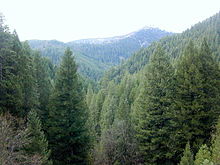
Coniferous Forest 


The Coniferous forest, located along the northern California coast, contains the largest life-form on Earth! The giant Sequoia trees are also the longest-lived life form on Earth. Some of these trees are 3,000 years old and counting!. Some coniferous trees depend on fire as a catalyst for seed-release. The Lodgepole Pine tree is an example of this kind of tree. The seeds develop in the pinecones, but unlike other conifers whose pinecones ripen and open to release the seeds, the Lodgepole's cones never ripen. The heat from naturally occurring fires force the Lodgepole Pine tree's serotinous cones to burst open, thus releasing the tree's seeds.

Temperature

-40°C to 20°C, average summer temperature is 10°C

Precipitation

300 to 900 millimeters of rain per year

Vegetation

Coniferous-evergreen trees (trees that produce cones and needles; some needles remain on the trees all year long)

Location

Canada, Europe, Asia, and the United States

Other

Coniferous forest regions have cold, long, snowy winters, and warm, humid summers; well-defined seasons, at least four to six frost-free months


Most conifers are evergreen and have small, needlelike leaves. Other conifers, including redcedars and cypresses, have tiny, scalelike leaves that cling to the stem. These trees are also evergreen. Larches and baldcypresses are conifers but they lose their leaves every year.

Conifer cones range from less than 1/2 inch (1.3 centimeters) long to more than 2 feet (61 centimeters) long. Conifers have two types of cones--male and female. In most conifers, both types grow on the same plant. The soft male cones produce and release pollen, then shrivel and die. The female cones are larger and become woody with age. Each of their scales has two structures called ovules, which contain eggs (female reproductive cells). Wind carries pollen from the male cones to the female cones, where the pollen fertilizes the egg. The ovules then develop into seeds. After the seeds become fully formed, they fall from the cones.

A few conifers have unusual, fleshy cones. Juniper seed cones resemble blueberries. Yew seed cones look like red berries with a single, large seed.

KINDS OF FORESTS


Many systems are used to classify the world's forests. Some systems classify a forest according to the characteristics of its dominant trees. A needleleaf forest, for example, consists of a forest in which the dominant trees have long, narrow, needlelike leaves. Such forests are also called coniferous (cone-bearing) because the trees bear cones. The seeds grow in these cones. A broadleaf forest is made up mainly of trees with broad, flat leaves.

Forests in which the dominant trees shed all their leaves during certain seasons of the year, and then grow new ones, are classed as deciduous forests. In an evergreen forest, the dominant trees grow new leaves before shedding the old ones. Thus, they remain green throughout the year.
In some other systems, forests are classified according to the usable qualities of the trees. A forest of broadleaf trees may be classed as a hardwood forest because most broadleaf trees have hard wood, which makes fine furniture. A forest of needleleaf trees may be classed as a softwood forest because most needleleaf trees have softer wood than broadleaf trees have.

Many scientists classify forests according to various ecological systems. Under such systems, forests with similar climate, soil, and amounts of moisture are grouped into formations. Climate, soil, and moisture determine the kinds of trees found in a forest formation. One common ecological system groups the world's forests into six major formations. They are (1) tropical rain forests, (2) tropical seasonal forests, (3) temperate deciduous forests, (4) temperate evergreen forests, (5) boreal forests, and (6) savannas. 


Tropical rain forests grow near the equator, where the climate is warm and wet the year around. The largest of these forests grow in the Amazon River Basin of South America, the Congo River Basin of Africa, and throughout much of Southeast Asia.

Of the six forest formations, tropical rain forests have the greatest variety of trees. As many as 100 species-none of which is dominant-may grow in 1 square mile (2.6 square kilometers) of land. Nearly all the trees of tropical rain forests are broadleaf evergreens, though some palm trees and tree ferns can also be found. In most of the forests, the trees form three canopies. The upper canopy may reach more than 165 feet (50 meters) high. A few exceptionally tall trees, called emergents, tower above the upper canopy. The understory trees form the two lower canopies.

The shrub and herb layers are sparse because little sunlight penetrates the dense canopies. However, many climbing plants and epiphytes crowd the branches of the canopies, where the sunlight is fullest.
Most of the animals of the tropical rain forests also live in the canopies, where they can find plentiful food. These animals include such flying or climbing creatures as bats, birds, insects, lizards, mice, monkeys, opossums, sloths, and snakes.

Tropical seasonal forests grow in certain regions of the tropics and subtropics. These regions have a definite wet and dry season each year or a somewhat cooler climate than that of the tropical rain forest. Such conditions occur in Central America, central South America, southern Africa, India, eastern China, and northern Australia and on many islands in the Pacific Ocean.

Tropical seasonal forests have a great variety of tree species, though not nearly as many as the rain forests. They also have fewer climbing plants and epiphytes. Unlike the trees of the rain forest, many tropical seasonal species are deciduous. The deciduous trees are found especially in regions with distinct wet and dry seasons. The trees shed their leaves in the dry season.

Tropical seasonal forests have a canopy about 100 feet (30 meters) high. One understory grows beneath the canopy. Bamboos and palms may form a dense shrub layer, and a thick herb layer blankets the ground. The animal life resembles that of the rain forest.

Temperate deciduous forests grow in eastern North America, western Europe, and eastern Asia. These regions have a temperate climate, with warm summers and cold winters.

The canopy of temperate deciduous forests is about 100 feet (30 meters) high. Two or more kinds of trees dominate the canopy, and another 15 to 25 kinds may be present. Most of the trees in these forests are broadleaf and deciduous. They shed their leaves in fall. The understory, shrub, and herb layers may be dense. The herb layer has two growing periods each year. Plants of the first growth appear in early spring, before the trees have developed new leaves. These plants die by summer and are replaced by plants that grow in the shade of the leafy canopy.

Large animals of the temperate deciduous forests include bears, deer, and, rarely, wolves. These forests are also the home of hundreds of smaller mammals and birds. Many of the birds migrate south in fall, and some of the mammals hibernate during the winter.

Some temperate areas support mixed deciduous and evergreen forests. In the Great Lakes region of North America, for example, the cold winters promote the growth of heavily mixed forests of deciduous and evergreen trees. Forests of evergreen pine and deciduous oak and hickory grow on the dry coastal plains of the Southeastern United States.

Temperate evergreen forests. In some temperate regions, the environment favors the growth of evergreen forests. Such forests grow along coastal areas that have mild winters with heavy rainfall. These areas include the northwest coast of North America, the south coast of Chile, the west coast of New Zealand, and the southeast coast of Australia. Temperate evergreen forests also cover the lower mountain slopes in Asia, Europe, and western North America. In these regions, the cool climate favors the growth of evergreen trees.

The strata and the plant and animal life vary greatly from one temperate evergreen forest to another. For example, the mountainous evergreen forests of Asia, Europe, and North America are made up of conifers. The coastal forests of Australia and New Zealand, on the other hand, consist of broadleaf evergreen trees.

Boreal forests are found in regions that have an extremely cold winter and a short growing season. The word boreal means northern. Vast boreal forests stretch across northern Europe, Asia, and North America. Similar forests also cover the higher mountain slopes on these continents.

Boreal forests, which are also called taiga, have the simplest structure of all forest formations. They have only one uneven layer of trees, which reaches up to about 75 feet (23 meters) high. In most of the boreal forests, the dominant trees are needleleaf evergreens-either spruce and fir or spruce and pine. The shrub layer is spotty. However, mosses and lichens form a thick layer on the forest floor and also grow on the tree trunks and branches. There are few herbs.

Many small mammals, such as beavers, mice, porcupines, and snowshoe hares, live in the boreal forests. Larger mammals include bears, caribou, foxes, moose, and wolves. Birds of the boreal forests include ducks, loons, owls, warblers, and woodpeckers.

Savannas are areas of widely spaced trees. In some savannas, the trees grow in clumps. In others, individual trees grow throughout the area, forming an uneven, widely open canopy. In either case, most of the ground is covered by shrubs and herbs, especially grasses. As a result, some biologists classify savannas as grasslands. Savannas are found in regions where low rainfall, poor soil, frequent fires, or other environmental features limit tree growth. 

The largest savannas are tropical savannas. They grow throughout much of Central America, Brazil, Africa, India, Southeast Asia, and Australia. Animals of the tropical savannas include giraffes, lions, tigers, and zebras.

Temperate savannas, also called woodlands, grow in the United States, Canada, Mexico, and Cuba. They have such animals as bears, deer, elk, and pumas.

Source : World Book 2005 

Related Posts Plugin for WordPress, Blogger...

Entri Populer