Showing posts with label needleleaf trees. Show all posts

DEFINITION GYMNOSPERM


Gymnosperm,  is the name of one of two large groups of seed plants. The plants have naked, or uncovered, seeds. The term gymnosperm comes from two Greek words meaning naked and seed. The other group, called the angiosperms, consists of plants whose seeds have a protective ovary (seed case).


The gymnosperms are a group of seed-producing plants that includes conifers, cycads, Ginkgo, and Gnetales. The term "gymnosperm" comes from the Greek word gymnospermos (γυμνόσπερμος), meaning "naked seeds", after the unenclosed condition of their seeds (called ovules in their unfertilized state). Their naked condition stands in contrast to the seeds and ovules of flowering plants (angiosperms), which are enclosed within an ovary. Gymnosperm seeds develop either on the surface of scales or leaves, often modified to form cones, or at the end of short stalks as in (Ginkgo).

The gymnosperms and angiosperms together compose the spermatophytes or seed plants. By far the largest group of living gymnosperms is the conifers (pines, cypresses, and relatives), followed by cycads, Gnetophytes (Gnetophyta, Ephedra and Welwitschia), and Ginkgo (a single living species).

Gymnosperms are vascular seed plants that display very prominent and large bodies, mainly in evergreen tree form. During the ancient past gymnosperms dominated the landscape with their size and abundance. However, in modern times, gymnosperms are represented by less than one thousand species.

The Structure of Gymnosperm Types

Coniferophyta (Conifers) The basic body plan of conifer is that of an evergreen tree. Evergreen in the fact that most of these trees do not drop all their leaves (or in this case, needles) at once in the fall and grow them all back at once in the spring as do deciduous trees. Larches and bald cypress trees are an exception, however.

Gymnosperms are woody perennials which are among the largest and oldest living plants. There are about 800 species of gymnosperms. About 600 are conifers such as the pines, firs, spruces, and balsams. These cone-bearing trees make up the largest division (group) of gymnosperms. The tropical and subtropical cycads, also gymnosperms, are among the most primitive living seed plants. The ginkgo, also called the maidenhair tree, is another primitive gymnosperm.

Many of the gymnosperms are evergreen with a wide variety in the structure of the leaves. They do not bear flowers. Tiny male cones produce the pollen, which is usually spread by the wind. The naked, or exposed, seeds are borne between the scales of the female cones and drop when they become ripe. Gymnosperms provide the source of many valuable products such as tar, turpentine, rosin, and timber.


DEFINITION OF CONIFER - CONIFEROUS FOREST


Conifer is any one of a large group of trees or shrubs that bears its seeds in cones. Most conifers have tall, straight trunks and narrow branches and grow in cold or cool climates. Common conifers include cedars, cypresses, firs, hemlocks, junipers, larches, pines, redwoods, sequoias, and yews. The cycad plant also bears cones, but it is not considered to be a conifer.

Conifers are one of the oldest groups of woody plants. Conifer fossils have been found in rocks that are about 300 million years old. Conifers include the largest, tallest, and oldest living things. The largest giant sequoia is about 275 feet (83.8 meters) high, and the base of its trunk has a circumference of 103 feet (31.4 meters). Redwoods, the tallest living trees, may tower more than 360 feet (110 meters) high. Some bristlecone pines are more than 4,600 years old.

Conifers form about 30 per cent of the world's forests. In North America, most of the wood used in houses and other buildings comes from conifers, especially Douglas-fir and loblolly pine. Conifers also provide much wood pulp for making paper and cardboard. In addition, millions of conifers are used every year as Christmas trees.

In southern Canada the Taiga mingles with the temperate deciduous forest in some places. In northern Canada, the Taiga gradually tapers off, and the Arctic Tundra begins. The Siberian Taiga in Russia and Asia often has taller trees.

The main feature of the northern temperate zone of Asia is the presence and great importance of conifer species. Their distribution is generally restricted to the temperate zone, while summer-green broadleaved species are dominant over the whole territory. Because of high fire sensitivity, the nemoral conifers can easily disappear from the communities leaving a great question for researchers; whether the pure broadleaved forests in densely populated and severely deforested regions were originally summer-green broadleaved or whether they used to be mixed with conifers before human influence. Conifer forests in those regions occur in very small areas, as a rule – not comparable in size with the areas of broadleaved forests.
On the other hand, many conifer species are adapted to extreme edaphic conditions within the temperate zone, such as water deficit, wind exposure, nutritionally poor soils, slope processes and others.

Coniferous Forest 


The Coniferous forest, located along the northern California coast, contains the largest life-form on Earth! The giant Sequoia trees are also the longest-lived life form on Earth. Some of these trees are 3,000 years old and counting!. Some coniferous trees depend on fire as a catalyst for seed-release. The Lodgepole Pine tree is an example of this kind of tree. The seeds develop in the pinecones, but unlike other conifers whose pinecones ripen and open to release the seeds, the Lodgepole's cones never ripen. The heat from naturally occurring fires force the Lodgepole Pine tree's serotinous cones to burst open, thus releasing the tree's seeds.

Temperature

-40°C to 20°C, average summer temperature is 10°C

Precipitation

300 to 900 millimeters of rain per year

Vegetation

Coniferous-evergreen trees (trees that produce cones and needles; some needles remain on the trees all year long)

Location

Canada, Europe, Asia, and the United States

Other

Coniferous forest regions have cold, long, snowy winters, and warm, humid summers; well-defined seasons, at least four to six frost-free months


Most conifers are evergreen and have small, needlelike leaves. Other conifers, including redcedars and cypresses, have tiny, scalelike leaves that cling to the stem. These trees are also evergreen. Larches and baldcypresses are conifers but they lose their leaves every year.

Conifer cones range from less than 1/2 inch (1.3 centimeters) long to more than 2 feet (61 centimeters) long. Conifers have two types of cones--male and female. In most conifers, both types grow on the same plant. The soft male cones produce and release pollen, then shrivel and die. The female cones are larger and become woody with age. Each of their scales has two structures called ovules, which contain eggs (female reproductive cells). Wind carries pollen from the male cones to the female cones, where the pollen fertilizes the egg. The ovules then develop into seeds. After the seeds become fully formed, they fall from the cones.

A few conifers have unusual, fleshy cones. Juniper seed cones resemble blueberries. Yew seed cones look like red berries with a single, large seed.

NEEDLELEAF FORESTS


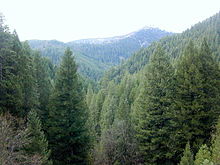
Needleleaf forests grow mainly in regions that have long, cold winters. These forests, which are also called softwood forests, stretch across Canada, northern Europe, and Siberia. Many firs, larches, and spruces grow in these northern forests, along with a few broadleaf trees, such as birches and willows. Some willows grow even farther north than needleleaf trees do. But they seldom reach more than shrub size. Needleleaf forests also blanket slopes in such mountain ranges as the Alps and the Rocky Mountains.


The Canadian needleleaf forests extend southward into the Western United States, where they include many of the world's largest trees. Many California redwoods tower over 300 feet (91 meters). Tall Douglas-firs also grow in the Western United States.

A few needleleaf forests grow in warmer regions. For example, the Southeastern United States has large forests of pines, such as loblolly pines and longleaf pines. These forests provide great quantities of wood for lumber and wood pulp.

NEEDLELEAF TRESS ARE ABOUT 500 SPECIES


Needleleaf trees include such familiar trees as firs, hemlocks, pines, redwoods, and spruces. There are about 500 species of needleleaf trees. Most of these trees have narrow, pointed, needlelike leaves. But a few types, such as cedars and junipers, have narrow, scalelike leaves.

Most needleleaf trees are evergreen, though they produce new needles each year. The oldest needles turn yellow or brown and drop, but the youngest needles remain green and do not fall. A few species of needleleaf trees are deciduous. One kind is the larch, which grows in northern forests throughout the world. Another deciduous needleleaf tree is the baldcypress that grows in swamps of the Southeastern United States.

Foresters call needleleaf trees softwoods because most of them have softer wood than broadleaf trees have. But the wood of Douglas-firs, yews, and some other needleleaf trees is hard.

Needleleaf trees belong to a group of plants called gymnosperms. Gymnosperms do not have flowers and their seeds are not enclosed to form fruits. Most gymnosperm trees bear their seeds in cones composed of hard scales. The seeds lie open on the surface of the scales. Botanists call such trees conifers.

Most conifers grow north of the equator. The conifers belong to four families-the pine, yew, cypress, and taxodium families. The pine family is by far the largest. It includes not only pines, but also such trees as firs, hemlocks, larches, and spruces. Pine trees make up a large genus (group of species) within the pine family. Loblolly pines, ponderosa pines, and white pines are a few North American members of this genus. The yew family includes such well-known ornamental trees as English yews and Japanese yews. Although yews are classified as conifers, they do not produce cones but cup-shaped "berries." Many members of the cypress family, such as arborvitae and junipers, have scalelike leaves and give off a spicy fragrance. The taxodium family includes baldcypresses and the largest of all living trees-the redwoods and giant sequoias.

Two conifer families-the podocarpus family and the araucaria family--grow mainly south of the equator. Podocarpus trees are tall evergreens with broader leaves than those of most needleleaf trees. The araucaria family includes the Chile pine. This strange-looking tree has snakelike branches covered with sharp, scaly leaves. It is sometimes called the monkey puzzle tree because its sharp leaves make it difficult to climb.

Fruit on the Tree

Fruit is the part of a flowering plant that contains the plant's seeds. In this sense, fruits include acorns, cucumbers, tomatoes, and wheat grains. However, the word fruit commonly refers to the juicy, sweet or tart kinds that people enjoy as desserts or snacks. The word comes from the Latin word frui, meaning enjoy. Popular fruits include apples, bananas, grapes, oranges, peaches, pears, and strawberries.


https://blogger.googleusercontent.com/img/b/R29vZ2xl/AVvXsEiq-Hnv5yMOTUyAzjAKpQktH5XEzQYUYyXUiZLBrUaSlDAwnNTgsCxAw0HnTGUoQ66AgGRjutaBRyQdAHfd2MoVPnbpvf5_oXG00AWIOlTYzzvk_MqDe5gFrix76upv58EqSW2DyFbM0m0/s1600/strawberries.jpg


Many fruits are nutritious as well as appetizing. For example, oranges and strawberries contain large amounts of vitamin C. Most fruits have a high sugar content, and so they provide quick energy. Fruits alone cannot provide a balanced diet, however, because the majority of them supply little protein.


http://kitsap.wsu.edu/food/images/banana.jpg


The world's fruit growers raise millions of tons of fruit annually. Fruit growing is a branch of horticulture, a field of agriculture that also includes the raising of nuts, vegetables, flowers, and landscape crops. Most nuts are actually fruits, as are the edible portion of such vegetables as cucumbers, green peppers, and tomatoes. To prevent confusion, horticulturists define a fruit as an edible seed-bearing structure that (1) consists of fleshy tissue and (2) is produced by a perennial. A perennial is a plant that lives for more than two years without being replanted. The horticultural definition of a fruit excludes nuts and vegetables. Nuts are firm rather than fleshy. Most vegetables are annuals-that is, the plants live for only one season.


http://thailand.ipm-info.org/images/crops/durian/Durian_fruits_in_tree.JPG


In some cases, the horticultural definition of a fruit conflicts with the definition used by botanists and with common usage. For example, watermelons and muskmelons are fruits, and most people regard them as such. But they grow on vines that must be replanted annually, and so horticulturists regard melons as vegetables. Rhubarb is sometimes considered a fruit because of its use as a dessert. But people eat the rhubarb leafstalk, not the seed-bearing structure. Therefore, horticulturists classify rhubarb as a vegetable.


                    How horticulturists classify fruits

Most of the fruits that are widely raised in North America were originally brought from other regions. For example, apples, cherries, and pears originated in Europe and western Asia. Apricots and peaches first came from China, and lemons and oranges from China and Southeast Asia. All these fruits are now grown in any part of the world that has a favorable climate.

Most fruit plants require considerable amounts of moisture. Dates and olives are among the few fruits that can be grown in dry regions without irrigation.

Horticulturists classify fruits into three groups, based on temperature requirements for growth: (1) temperate fruits, (2) subtropical fruits, and (3) tropical fruits.


http://www.localecology.org/images/strawberry_tree_fruit.JPG


Temperate fruits must have an annual cold season to grow properly. They are raised chiefly in the Temperate Zones, the regions between the tropics and the polar areas. Most temperate fruits are grown in Europe and North America, but Asia and Australia also have major producing areas.

The principal temperate fruits are apples, apricots, cherries, peaches, pears, and plums. In addition, most small fruits, which grow on plants smaller than trees, are raised mainly in the Temperate Zones. They include blueberries, cranberries, grapes, raspberries, and strawberries.

Subtropical fruits require warm or mild temperatures throughout the year but can survive an occasional light frost. They are grown chiefly in subtropical regions.

The most widely grown subtropical fruits are the citrus group, which includes grapefruit, lemons, limes, and oranges. Oranges, the leading citrus crop, are grown throughout the subtropics, from southern Japan to southern Europe. In the United States, Florida produces by far the most oranges. Other subtropical fruits include dates, figs, olives, and avocados.

Tropical fruits are raised mainly in the tropics and cannot stand even a light frost. Bananas and pineapples, the best-known tropical fruits, are grown throughout the tropics, and much of each crop is exported. Other tropical fruits include acerolas, cherimoyas, litchis, mangoes, mangosteens, and papayas.


                    Growing fruit

Almost all species of fruits grow on plants that have a woody stem. Such plants are trees, bushes, or woody vines. Fruits that grow on trees include apples, cherries, lemons, limes, oranges, and peaches. Most small fruits grow on bushes, but grapes come from woody vines. Bananas and strawberries grow on plants that have a nonwoody stem.

 http://www.cmorane.com/wp-content/uploads/2010/07/strawberries.jpg

Fruit crops, unlike most other crops, are not grown from seeds. Plants grown from seeds may vary in many ways from generation to generation. But growers strive to produce plants that will bear fruits of uniform type, appearance, and quality. Such fruits bring the highest prices when marketed. Fruit plants produce fruits of uniform quality if grown vegetatively-that is, from certain parts of desirable plants, such as stems, buds, and roots. The part that is grown develops new tissues and new parts identical to those of the parent plant.

Fruit plants are produced vegetatively in three main ways: (1) by grafting, (2) from cuttings, and (3) from specialized plant structures. Most fruit trees are reproduced by grafting. In this process, a bud or piece of stem from one tree is joined to a rootstock from another. A rootstock is a root or a root plus its stem. The resulting tree will have most of the same characteristics as the tree from which the bud or stem was taken. However, the rootstock may determine such characteristics as the size and productivity of the new tree.

Some fruit plants are produced from cuttings or from specialized structures. Most cuttings are pieces of stem that grow roots when placed in water or moist soil. Specialized structures called runners are used to grow strawberry plants. Runners are long, slender shoots that mature strawberry plants send out along the ground. A runner placed in soil develops into a new plant.

Some fruit growers produce their own plants vegetatively. However, most growers buy their plants from nurseries that specialize in producing them.

The branch of horticulture that deals with fruit growing is called pomology. Pomologists have developed highly efficient methods of planting and caring for fruit crops, and most fruit farms use these techniques.

There are three main steps in growing fruit: (1) planting, (2) caring for the crop, and (3) harvesting.

Planting. Fruit crops are perennials, and so they do not have to be replanted annually as do most other crops. After the original planting, a fruit farmer need only replace plants that become unproductive. Many fruit plants remain productive for 30 to 50 years or even longer. In mild climates, farmers generally plant trees, bushes, and vines in fall. In cold climates, planting usually takes place in spring.

Most bushes are planted from 3 to 5 feet (0.9 to 1.5 meters) apart in rows that are 6 to 10 feet (1.8 to 3 meters) apart. Rows of grapevines are spaced about 10 feet (3 meters) apart. In the past, farmers almost always grew full-sized fruit trees. In most cases, the trees were planted from 20 to 40 feet (6 to 12 meters) apart to allow room for growth. Today, many farmers prefer to grow dwarf trees, which are planted close together. The branches of each tree may grow up a supporting framework called a trellis. The trellis enables all the fruit to receive maximum sunlight, and so the crop ripens better and faster than it otherwise would. Fruit is also easier to harvest from dwarf trees than from full-sized trees.

Caring for the crop. Most fruit growers use special machinery to fertilize, cultivate, and otherwise care for their crops. Fruit crops must be fertilized at least once a year. Some fertilizers are applied to the soil, and others are sprayed on the plants. Many fruit growers cultivate the soil around young fruit plants periodically. This practice helps control weeds and thus encourages crop growth. Most fruit crops grown in extremely dry regions must be irrigated. Farmers use various methods, such as ditches and sprinklers, to distribute irrigation water.

In many cases, the branches of a young fruit tree must be trained so that the tree develops a uniform shape and a sturdy structure. Training may involve propping the trunk or tying the branches, or it may consist entirely of pruning. Pruning strengthens a plant by ridding it of unproductive branches. Nearly all fruit plants have to be pruned at least once annually. In addition, most farmers remove some of the crop from the trees during the early stages of the fruit's growth. This practice, called thinning, helps increase the size of the remaining fruit.

The majority of fruit growers use chemical pesticides to protect their crops against diseases and insect pests. Most pesticides are sprayed or dusted on crops by tractor-driven machinery or specially equipped light airplanes or helicopters. Plant breeders have also developed varieties of fruit plants that resist certain diseases and harmful insects.

Sudden spring frosts can endanger fruit crops in temperate or subtropical regions. Farmers use water distributed by sprinklers to protect small-fruit crops from frosts. Water releases heat as it freezes. If it is sprinkled onto the crops continuously, it keeps the tender flowers and young fruits from freezing. Farmers use heaters to protect tree crops from spring frosts.


http://www.timeoutsydney.com.au/restaurants/pantry/large-pears-32.jpg


Harvesting. Most fruits ripen rapidly after reaching their mature size. Harvesting occurs during different stages of the growth process, depending on the type of fruit and its intended use. For example, gooseberries and cherries used in making artificial coloring are harvested when immature. Apples, bananas, peaches, and pears are usually harvested when mature, but before they ripen. Berries and most fruit picked at home orchards are harvested during the ripening stage. Most fruits taste best when they are allowed to ripen on the plant. Citrus fruits do not go through a distinct ripening process and may be harvested over a long period of time after they mature. Fruits are bruised more easily than most other crops, and so they must be harvested with greater care. Most are picked by hand. However, the increasing cost of hand labor has encouraged the use of fruit-harvesting machines. Some of these machines have arms that shake the fruit loose from the plants. The loosened fruit drops onto outstretched cloths. Other mechanical pickers have fingers that "comb" fruit from the plants.

                    Marketing fruit

The United States is the leading fruit-producing country in the world. It raises more than 10 percent of all the apples, pineapples, and plums; about 20 percent of the lemons, oranges, peaches, and strawberries; and about 45 percent of the grapefruit. California is the nation's chief fruit-growing state. Other leading states include Florida, Michigan, New York, Oregon, and Washington.

Most fruit scheduled to be sold fresh is taken from the orchard or field by truck and delivered to a packing house. Many large fruit farms have their own packing facilities. Commercial packing houses are centrally located in fruit-growing regions. Most large packing houses are fully mechanized. Machines wash the fruit, sort it according to size and quality, and pack each batch into containers. The fruit is then shipped to market or stored for future delivery. Railroads and trucks carry most overland shipments of fruit. Most overseas shipments travel by ocean freighter.

Fruits can be stored for varying lengths of time under controlled conditions. Temperate tree fruits must be stored at temperatures near freezing. Some kinds of apples can be kept fresh for about a year under such conditions. On the other hand, most small fruits remain fresh only a few days or weeks in cold storage. Tropical and subtropical fruits can be stored for a few weeks or months under temperature-controlled conditions. The temperatures, though cool, must be well above freezing. The amount of oxygen ordinarily present in the air promotes spoilage of fruit. The storage time for all fruits can be lengthened by reducing the oxygen supply.

Much fruit is shipped directly from farms to food processors. Processing plants preserve fruit by such methods as canning, drying, and freezing.


                    Developing new varieties of fruit

Over the centuries, fruits have been improved by constant selection of the most desirable plants. In selection, plants grown from seed are examined for various desirable qualities. Individual plants are singled out for high productivity or for the superior color, texture, or flavor of their fruits. If the desirable characteristics of the selected plant are reproduced when the plant is grown vegetatively, the selection may be classed as a new cultivated variety. Cultivated varieties are also known as cultivars.

Occasionally, an individual plant develops an unexpected characteristic due to a mutation, a random genetic change. For example, an apple tree may suddenly start to bear fruit of a more intense red color. Horticulturists refer to such a mutation as a sport. Growers have used sports to develop many improved varieties of fruit. The trees of Delicious apples originally produced pale-colored, striped fruits. Some branches on individual trees began to bear solid-red apples. By grafting these branches onto appropriate rootstocks, growers produced the attractively colored types of Delicious apples available today.

Horticultural plant breeders use a technique called crossing or hybridization to improve fruits. In this process, pollen is taken from a plant that has been selected for a particular desirable trait. The pollen is placed in the flower of a plant selected for another desirable quality. Some of the plants grown from the resulting seed may have the desirable characteristics of both parents. Occasionally, one of these plants may prove worthy of being named as a new variety. In many cases, hybridization and selection are repeated over many generations to create a new variety. Hybridization is a highly useful technique because it enables breeders to produce varieties with combinations of more and more desirable qualities. In the future, desirable characteristics may be transferred using techniques of genetic engineering that remove genes from one plant and insert them into another.

SPECIALIZED LEAVES

Some leaves have special functions along with or instead of food making. Such specialized leaves include (1) protective leaves, (2) storage leaves, (3) tendrils, (4) bracts, and (5) insect-capturing leaves.
Protective leaves include bud scales, prickles, and spines. As described earlier, bud scales are specialized leaves that protect the young, undeveloped tissues of the bud. Bud scales are short and broad, and they overlap like roof shingles. In many plants, the bud scales have an outer layer of waterproof cells. Prickles and spines are sharp leaf structures that protect the plant from being eaten. For instance, prickles cover the leaves of the Canada thistle. The prickles protect the plant from grazing animals. Many cactuses have clusters of spines. In many species of cactuses, the pointed spines replace the leaves on the mature plants. In these plants, the green stem has the job of photosynthesis.

Storage leaves. Most plants store food in their roots or stems. However, some plants have special leaves that hold extra food. Onion and tulip bulbs, for example, consist mainly of short, fat storage leaves called bulb scales. These leaves cannot make food. Their job is to store food underground during the winter months.

BULB. Many plants that grow in dry places have thick leaves that store water. The mosslike stonecrop plants that grow on rocky cliffs in the Southwestern United States have such leaves.

leaf


Tendrils are slender, whiplike structures that help hold climbing plants in place. They wrap around twigs, wires, and other solid objects. Among many climbing plants, specialized leaves serve as tendrils. For example, climbing garden peas have compound leaves in which the upper leaflets are threadlike tendrils. In one kind of sweet pea, a garden flower, the entire leaf blade becomes a tendril. The plant's stipules enlarge and take over the food-making job. In the greenbrier vine, the stipules form long, curving tendrils.


Bracts grow just below the blossoms of certain plants. Most bracts are smaller and simpler in shape than a plant's regular leaves. Many members of the daisy family-including daisies, goldenrods, marigolds, and sunflowers-have bracts. These bracts form a cup beneath the plant's cluster of flowers. A few kinds of plants, such as the flowering dogwood and poinsettia, have large, showy bracts. These bracts look like part of the flower, but they are not.

Insect-capturing leaves. Carnivorous (meat-eating) plants, such as the butterwort, pitcher plant, sundew, and Venus's-flytrap, have leaves that capture insects. These leaves, like other leaves, can make food using sunlight. But they also have features that attract, trap, and then digest insects. Plants with insect-capturing leaves grow in wetlands, where the soil contains little nitrogen. They obtain this necessary nutrient from the captured insects. For a description of these plants and their leaves.  << --- Next>>>
Related Posts Plugin for WordPress, Blogger...

Entri Populer