Showing posts with label CHARACTERISTICS OF SOIL. Show all posts

CLAY IS A SUBSTANCE PRESENT IN MOST KINDS OF SOIL

Clay is a substance present in most kinds of soil. Geologists define clay as extremely small particles of soil that measure less than 4 microns, or 0.000157 inch, in diameter. The word clay also refers to earthy material composed of certain kinds of silicate minerals that have been broken down by weathering.

Clay consists mainly of tiny, sheetlike particles of alumina and silica bound together by water. Various other materials in clay may give it different colors. For example, iron oxide may color clay red. Clays that contain various amounts of carbon compounds may be different shades of gray.
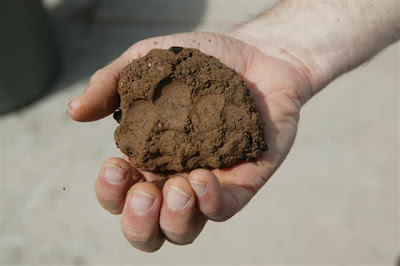


The clay in soil has a vital role in farming. For example, it absorbs ammonia and other gases needed for plant growth. Clay also helps soil retain minerals necessary for plant growth. Without clay, soil would not keep its fertility from year to year. However, too much clay makes soil stiff and heavy and prevents the movement of air and water through soil.

There are two general types of clay, based on how the substance reacts when mixed with water. Expandable clay swells when water is added to it. Expandable clay can absorb so much water that the clay itself becomes a liquid. Nonexpandable clay becomes soft but not liquid when mixed with water.

The petroleum industry uses expandable clays called bentonites to make drilling mud. The petroleum industry also uses another kind of expandable clay as a chemical agent in the process of oil refining.


Ceramics industries use nonexpandable clay in making bricks, pottery, tile, and many other products. For example, pottery makers mold moist clay into almost any shape and bake it in hot ovens called kilns. Heat removes the water from the clay, which becomes permanently hard and cannot be softened by adding water to it. The whitest kind of clay, kaolin or china clay, is used in making porcelain. The paper industry also uses kaolin, which serves as a filler that adds whiteness and strength to paper. In addition, kaolin gives some kinds of paper a smooth, shiny surface. Fire clay contains a large percentage of silica and can stand high temperatures. It is used in making firebrick and furnace linings.

SOIL CONSERVATION

Soil is essential for the growth of plants, which in turn provide food for animals and human beings. Soil consists chiefly of minerals mixed with organic (plant and animal) matter. Soil forms from rocks and similar materials that are broken up into smaller particles by physical and chemical processes called weathering. The particles become mixed with humus, a substance formed from plant and animal remains. Bacteria in the soil break down the humus into nutrients needed by plants.

The thin layer of fertile soil that covers much of the land was formed by natural processes over thousands of years. But in many areas, careless human practices have destroyed the soil in just a few years.

Rain, wind, and other natural forces gradually wear away the soil. This process, called erosion, normally occurs slowly. But people have greatly increased the rate of soil erosion by removing natural vegetation to clear land for construction projects, mines, or farmland. Plants protect soil from rain and wind. Their roots form an underground network that holds soil in place. Plants also absorb some rain water so that less runs off the land. Thus, fewer soil particles are washed away.

Soil erosion has long been a major conservation problem, especially on croplands. In the United States, soil erosion has severely damaged millions of acres or hectares of land. Much of the soil eroded each year ends up in lakes, streams, and rivers.

Farmers can reduce soil erosion by planting trees and leaving patches of natural vegetation between their fields and on other unplowed areas. The trees serve as windbreaks, and the plant cover slows the runoff of rain water. Many farmers also practice such soil conservation methods as contour plowing, strip cropping, terracing, and minimum tillage.


Contour plowing is practiced on sloping land. Farmers plow across a slope, instead of up and down. The plowed soil forms ridges across the slope. The ridges help slow the flow of rain water.

Strip cropping also helps slow the flow of rain water down a slope. Farmers plant grass, clover, or other close-growing plants in strips between bands of corn, wheat, or other grain crops. Grass and clover hold water and protect the soil better than grain crops do.

Terracing helps prevent soil erosion on hillsides. Farmers build wide, flat rows called terraces on the hillsides. A terraced hillside resembles a large staircase. The terraces hold rain water and so prevent it from washing down the hillside and forming gullies.

Minimum tillage, also called conservation tillage, consists of several methods of reducing the number of times a field must be tilled. Normally, farmers till their fields three or more times each growing season. One form of minimum tillage is called zero-tillage or no-till. After harvesting a crop, farmers leave the residues (remains) from the crop on the field as a covering for the soil, instead of plowing them under. During the next planting, the farmer prepares the seedbed with a device that leaves the residues between the crop rows. Zero-tillage not only provides cover for the soil but also conserves tractor fuel.

Another major conservation problem on farmlands is declining soil fertility, which is caused partly by planting the same crop in a field year after year. Corn, wheat, and other grain crops drain the soil of an essential chemical called nitrogen if they are grown on the same field for several years. Farmers can maintain the fertility of the soil by practicing crop rotation, in which crops are alternated from year to year. The rotation crop is usually a legume, such as alfalfa or soybeans. Unlike corn and wheat, legumes restore nitrogen to the soil.

Some farmers add plant remains or manure (animal wastes) to their fields to enrich the soil. Many use chemical fertilizers for this purpose. However, excessive use of some chemical fertilizers may decrease the ability of bacteria to decay humus and produce nutrients naturally. As a result, the soil may gradually harden and lose much of its ability to absorb rain water. The soil then erodes more easily. In addition, the chemicals from fertilizers may wash out of the soil and enter lakes, streams, and even wells, polluting the water. Excessive use of pesticides causes similar problems.

A common problem on irrigated farmland is the build-up of various chemical salts in the soil. Most irrigation water contains small amounts of these salts. In time, the salts accumulate in the soil and may reduce plant growth and ruin cropland.

SOIL CONSERVATION

The soils of farmlands, grazing lands, and forestlands provide many products and recreational areas. Soil conservationists work to ensure the wise use of these soils.

Wise use of farmlands involves maintaining a high level of nutrients and organic matter in cultivated soils. Farmers add organic matter to the soil by plowing under certain green plants. They also add fertilizers and rotate crops to replace nutrients that leaching and growing plants remove. In addition, farmers plow and plant their fields in ways that control erosion.


Grazing lands that have been overgrazed also suffer from erosion. Overgrazing decreases the amounts of plant life and organic matter in the soil, and the soil erodes easily. Ranchers conserve grazing lands by limiting the time that their herds graze in one area.

Forestlands also must be protected from erosion. In some cases, foresters leave unusable branches and other parts of trees on the forest floor to add organic matter to the soil. They also develop large groups of trees whose roots protect the soil by holding it in place against wind and water erosion.

CLASSIFIED SOILS IN THE TROPICS


Classified Soils in the Tropics According to the USDA Soil Taxonomy, Oxisols are the most abundant soils in the humid and perhumid tropics covering about 35 percent of the land area. Ultisols are the second most abundant, covering an estimated 28 percent of the region. About half of the Ultisols and 60 percent of the Oxisols are located in humid and perhumid tropical Africa and Asia. In tropical Africa, they are abundant in the eastern Congo basin bordering the lake region; in the forested zones of Sierra Leone; in Ivory Coast; in parts of Liberia; and in the forested coastal strip from Ivory Coast to Cameroon.


The Alfisols, which have high to moderate fertility, cover a smaller area of the humid tropics. In west Africa they are found in Ivory Coast, Ghana, Togo, Benin, Nigeria and Cameroon. They are, however, the most abundant soils in Africa's subhumid and semi-arid zones, covering about one third of these regions. The Alfisols are widely distributed in the subhumid and semi-arid tropical regions of Africa, including large areas in western, eastern, central, and southeastern Africa.

Table. Geographical distribution of soils in the humid and semi-arid tropics
(millions of hectares).
 
Soil order
Tropical Africa
Tropical Asia
Tropical America
Total
Percent
Humid Tropics1)


Oxisols
179
14
332
525
35
Ultisols
69
131
213
413
28
Alfisols
21
15
18
54
4
Others
176
219
103
498
33
Total
445
379
666
1490
100
Semi-arid Tropics2)


Alfisols
466
121
107
694
33
Ultisols
24
20
8
52
1
Others
972
178
198
1348
66
Total
1462
319
313
2094
100
1) Data from NAP (1982).
2) Data adapted from Kampen and Burford (1980). Part of the subhumid tropics is included.

CHARACTERISTICS OF SOIL

The method and rate of soil formation differs throughout a body of soil. As a result, the soil develops layers. These layers are called soil horizons. Soil horizons may be thick or thin, and they may resemble or differ from the surrounding horizons. The boundaries between the layers can be distinct or barely noticeable.

Most soils include three major horizons. The upper two, called the A and B horizons, are the most highly developed layers. The A horizon is also known as topsoil. The lowest horizon, called the C horizon or the subsoil, is exposed to little weathering. Its composition resembles that of the parent material. Pedologists describe soils by the characteristics of the soil horizons, including (1) color, (2) texture, (3) structure, and (4) chemical conditions.


Color. Soils range in color from yellow and red to dark brown and black. The color of a soil helps pedologists estimate the amounts of air, water, organic matter, and certain elements in the soil. For example, a red color may indicate that iron compounds are present in the soil.

Texture of a soil depends on the size of its mineral particles. Sands are the largest particles. The individual grains can be seen and felt. Silts are just large enough to be seen, and clays are microscopic. Pedologists divide soils into textural classes according to the amounts of sand, silt, and clay in a soil. For example, the mineral portions of soils classified as loam contain from 7 to 27 per cent clay and less than 52 per cent sand. In silty clay, more than 40 per cent of the mineral particles are clay, and more than 40 per cent are silt. Texture helps determine how thoroughly water drains from a soil. Sands promote drainage better than clays.

Structure. When soil particles aggregate, they form clumps of soil that are called peds. Most peds range from less than 1/2 to 6 inches (1.3 to 15 centimeters) in diameter. Their shape and arrangement determine a soil's structure. The ability of peds and soil particles to stick together and hold their shape is called consistence.

Most soils contain two or more kinds of structures. Some soils have no definite structure. In some such soils, the peds lack a definite shape or arrangement. In others, the particles do not aggregate.

There are three main kinds of soil structures: (1) platelike, (2) prismlike, and (3) blocklike. Platelike peds are thin, horizontal plates that occur in any horizon. Prismlike peds are column-shaped subsoil structures. Blocklike peds look like blocks with flat or curved sides. Large, flat-sided, blocklike peds commonly occur in subsoils. Small, rounded, blocklike peds make up most topsoils. They contain more organic matter and hold water and nutrients better than do larger peds.

Chemical conditions. Soils can be acid, alkaline, or neutral. The amounts of acid and alkali in a soil influence the biological and chemical processes that take place there. Highly acid or alkaline soils can harm many plants. Neutral soils support most of the biological and chemical processes, including the process by which green plants obtain many nutrients. This process is called cation exchange. Many nutrients and other elements dissolve in the soil solution, forming positively charged particles called cations. The negatively charged clay and humus attract some cations and prevent them from being leached (washed away) from the topsoil by drainage waters. The solution that remains in the soil contains other cations. Nutrient cations on the clay and humus and those in the soil solution change places with nonnutrient cations that are on roots. The roots can then absorb the nutrients.
Related Posts Plugin for WordPress, Blogger...

Entri Populer