DEFINITION OF CONIFER - CONIFEROUS FOREST


Conifer is any one of a large group of trees or shrubs that bears its seeds in cones. Most conifers have tall, straight trunks and narrow branches and grow in cold or cool climates. Common conifers include cedars, cypresses, firs, hemlocks, junipers, larches, pines, redwoods, sequoias, and yews. The cycad plant also bears cones, but it is not considered to be a conifer.

Conifers are one of the oldest groups of woody plants. Conifer fossils have been found in rocks that are about 300 million years old. Conifers include the largest, tallest, and oldest living things. The largest giant sequoia is about 275 feet (83.8 meters) high, and the base of its trunk has a circumference of 103 feet (31.4 meters). Redwoods, the tallest living trees, may tower more than 360 feet (110 meters) high. Some bristlecone pines are more than 4,600 years old.

Conifers form about 30 per cent of the world's forests. In North America, most of the wood used in houses and other buildings comes from conifers, especially Douglas-fir and loblolly pine. Conifers also provide much wood pulp for making paper and cardboard. In addition, millions of conifers are used every year as Christmas trees.

In southern Canada the Taiga mingles with the temperate deciduous forest in some places. In northern Canada, the Taiga gradually tapers off, and the Arctic Tundra begins. The Siberian Taiga in Russia and Asia often has taller trees.

The main feature of the northern temperate zone of Asia is the presence and great importance of conifer species. Their distribution is generally restricted to the temperate zone, while summer-green broadleaved species are dominant over the whole territory. Because of high fire sensitivity, the nemoral conifers can easily disappear from the communities leaving a great question for researchers; whether the pure broadleaved forests in densely populated and severely deforested regions were originally summer-green broadleaved or whether they used to be mixed with conifers before human influence. Conifer forests in those regions occur in very small areas, as a rule – not comparable in size with the areas of broadleaved forests.
On the other hand, many conifer species are adapted to extreme edaphic conditions within the temperate zone, such as water deficit, wind exposure, nutritionally poor soils, slope processes and others.

Coniferous Forest 
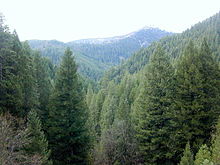

The Coniferous forest, located along the northern California coast, contains the largest life-form on Earth! The giant Sequoia trees are also the longest-lived life form on Earth. Some of these trees are 3,000 years old and counting!. Some coniferous trees depend on fire as a catalyst for seed-release. The Lodgepole Pine tree is an example of this kind of tree. The seeds develop in the pinecones, but unlike other conifers whose pinecones ripen and open to release the seeds, the Lodgepole's cones never ripen. The heat from naturally occurring fires force the Lodgepole Pine tree's serotinous cones to burst open, thus releasing the tree's seeds.

Temperature

-40°C to 20°C, average summer temperature is 10°C

Precipitation

300 to 900 millimeters of rain per year

Vegetation

Coniferous-evergreen trees (trees that produce cones and needles; some needles remain on the trees all year long)

Location

Canada, Europe, Asia, and the United States

Other

Coniferous forest regions have cold, long, snowy winters, and warm, humid summers; well-defined seasons, at least four to six frost-free months


Most conifers are evergreen and have small, needlelike leaves. Other conifers, including redcedars and cypresses, have tiny, scalelike leaves that cling to the stem. These trees are also evergreen. Larches and baldcypresses are conifers but they lose their leaves every year.

Conifer cones range from less than 1/2 inch (1.3 centimeters) long to more than 2 feet (61 centimeters) long. Conifers have two types of cones--male and female. In most conifers, both types grow on the same plant. The soft male cones produce and release pollen, then shrivel and die. The female cones are larger and become woody with age. Each of their scales has two structures called ovules, which contain eggs (female reproductive cells). Wind carries pollen from the male cones to the female cones, where the pollen fertilizes the egg. The ovules then develop into seeds. After the seeds become fully formed, they fall from the cones.

A few conifers have unusual, fleshy cones. Juniper seed cones resemble blueberries. Yew seed cones look like red berries with a single, large seed.

BROADLEAF FORESTS


Broadleaf forests grow in regions that have a fairly long growing season and plentiful rainfall. Every continent except Antarctica has broadleaf forests, which are also called hardwood forests. In areas with cold, snowy winters, almost all the trees in broadleaf forests lose their leaves each autumn. In tropical areas, most broadleaf trees are evergreen.

Before the 1800's, broadleaf forests covered much of the Eastern United States. They included such trees as ashes, birches, maples, and oaks. During the 1800's, most of the trees in these forests were cut down to provide lumber and fuel and to make room for farms and cities. Today, only a few parts of the Eastern United States have large broadleaf forests. Western Europe also had great forests of broadleaf trees, including ashes, beeches, and oaks. But most of these forests have been cut down.

Broadleaf forests that consist largely of quaking aspens and balsam poplars cover parts of southern Canada and large areas of southern Siberia. Forests of birches and oaks grow in eastern Europe and along the Yellow Sea coast of China and Korea. Southeastern Australia has valuable forests of eucalyptus trees. These broadleaf trees grow nearly as tall as California's needleleaf giants, the redwoods. Some eucalyptus trees stand more than 300 feet (91 meters) tall. About 600 kinds of eucalyptus trees grow in Australia. Almost all of these trees are evergreen.

In many areas, mixed forests of broadleaf and needleleaf trees grow alongside broadleaf or needleleaf forests. Central Canada, the Eastern United States, central and southern Europe, and eastern Asia all have large mixed forests.

Remarkable broadleaf forests grow in tropical regions where the weather is always hot and rain falls regularly every month of the year. In these tropical rain forests, many of the trees look alike. They are tall, and many tower more than 150 feet (46 meters). The trees have leathery, dark-green leaves. Because the trees receive plenty of moisture throughout the year, most of them are evergreen. The trees may thus look alike, but they belong to many species. Many palms grow among the broadleaf trees in the tropical rain forests. The largest rain forests are in South and Central America, central Africa, and Southeast Asia.

NEEDLELEAF FORESTS


Needleleaf forests grow mainly in regions that have long, cold winters. These forests, which are also called softwood forests, stretch across Canada, northern Europe, and Siberia. Many firs, larches, and spruces grow in these northern forests, along with a few broadleaf trees, such as birches and willows. Some willows grow even farther north than needleleaf trees do. But they seldom reach more than shrub size. Needleleaf forests also blanket slopes in such mountain ranges as the Alps and the Rocky Mountains.


The Canadian needleleaf forests extend southward into the Western United States, where they include many of the world's largest trees. Many California redwoods tower over 300 feet (91 meters). Tall Douglas-firs also grow in the Western United States.

A few needleleaf forests grow in warmer regions. For example, the Southeastern United States has large forests of pines, such as loblolly pines and longleaf pines. These forests provide great quantities of wood for lumber and wood pulp.

NEEDLELEAF TRESS ARE ABOUT 500 SPECIES


Needleleaf trees include such familiar trees as firs, hemlocks, pines, redwoods, and spruces. There are about 500 species of needleleaf trees. Most of these trees have narrow, pointed, needlelike leaves. But a few types, such as cedars and junipers, have narrow, scalelike leaves.

Most needleleaf trees are evergreen, though they produce new needles each year. The oldest needles turn yellow or brown and drop, but the youngest needles remain green and do not fall. A few species of needleleaf trees are deciduous. One kind is the larch, which grows in northern forests throughout the world. Another deciduous needleleaf tree is the baldcypress that grows in swamps of the Southeastern United States.

Foresters call needleleaf trees softwoods because most of them have softer wood than broadleaf trees have. But the wood of Douglas-firs, yews, and some other needleleaf trees is hard.

Needleleaf trees belong to a group of plants called gymnosperms. Gymnosperms do not have flowers and their seeds are not enclosed to form fruits. Most gymnosperm trees bear their seeds in cones composed of hard scales. The seeds lie open on the surface of the scales. Botanists call such trees conifers.

Most conifers grow north of the equator. The conifers belong to four families-the pine, yew, cypress, and taxodium families. The pine family is by far the largest. It includes not only pines, but also such trees as firs, hemlocks, larches, and spruces. Pine trees make up a large genus (group of species) within the pine family. Loblolly pines, ponderosa pines, and white pines are a few North American members of this genus. The yew family includes such well-known ornamental trees as English yews and Japanese yews. Although yews are classified as conifers, they do not produce cones but cup-shaped "berries." Many members of the cypress family, such as arborvitae and junipers, have scalelike leaves and give off a spicy fragrance. The taxodium family includes baldcypresses and the largest of all living trees-the redwoods and giant sequoias.

Two conifer families-the podocarpus family and the araucaria family--grow mainly south of the equator. Podocarpus trees are tall evergreens with broader leaves than those of most needleleaf trees. The araucaria family includes the Chile pine. This strange-looking tree has snakelike branches covered with sharp, scaly leaves. It is sometimes called the monkey puzzle tree because its sharp leaves make it difficult to climb.

FOREST PROTECTION

Definition of Forest Protection is a business, activity, and measures to prevent the destruction of forests and forest products due to human actions or natural. Causes of deforestation can be forest fires, pests, diseases, grazing, theft and causing protection factor. One of the principles of forest protection is the prevention of the onset or progression of a cause of forest destruction , would be more effective than control activities after the damage occurred.

The principle of priority to the prevention of forest protection onset or progression of a forest damage through silvicultural planning and good management.

In conjunction with the management measures, prevention of the concept of forest protection is approached by way of:

  • decision to move or act to prevent the causes of forest destruction is not developed and does not cause deforestation seriously.
  • development of a form of forest management is careful and insightful future.

Studies of forest protection in general as well studied as part of the Science Silviculture . Forest Protection Branch of Science has developed into a more specific knowledge of science among the Forest Diseases, Pests of Forest Science and Forest Fire.

FOREST PROTECTION STRATEGY


Several forest protection strategies that can be used to achieve sustainable forest management are:
  1. understand the interaction with the agent of forest destruction so that:
    • can identify the factors that cause problems in forest protection
    • can identify the cause of primary damage
  2. can analyze and make decisions as a whole and not just limited to the most serious causes of damage
  3. always seen as a forest protection measures are not separate from silvicultural
  4. aware that forest protection is increasingly important and the approach is not limited to field crops but excluding forest products.
Protection strategies in addition to ensuring the sustainability of forest management can also ensure a low risk of forest management.

FOREST DEGRADATION IN INDONESIA


When the rainy season floods everywhere, many people say that this is due to forest destruction. Flooding is just one result of the impact of deforestation on the environment. Not only floods during the rainy season, the danger of drought occurs when the dry season comes. When the forest is still well preserved has the trees are dense, the forest can absorb water when the rains come and save them in the soil in the crevices of the roots , then release it slowly through the watershed . Forests control the fluctuation of the water in the river during the rainy season so it does not overflow during the dry season and not dry. Here the forest functions as a regulator of hydro-orologis for human life and other living creatures.

In addition to flooding and drought, there are many more negative effects of deforestation. Damage to the forest environment like this is a human-induced damage to the cutting down of trees in the headwaters of the river even clearing the converted in other uses.

Understanding and definition of forest degradation is the reduction in forest area due to damage to ecosystems that are often called forest degradation and deforestation as well plus the conversion of forest land or the term deforestation .

CIFOR study (International Forestry Research) examine the causes of forest cover change which consists of shifting cultivation, encroachment, transmigration, mining , plantation, plantations, logging and timber industry. Besides illegal logging activities carried out by professional groups or smugglers who illegally supported by rogue elements.

The opening of forests for oil palm plantations be accused as one of the causes of forest destruction. Forest in which there are many different types of trees turned into monoculture, causing loss of biodiversity and the balance of ecological in the area. Some types of animals that make the forest as its habitat will move to find a more suitable place to live.

Land clearing for oil palm plantations in tropical forests is one of the trigger fires and forest negative impact on greenhouse gas emissions.

Recent research results of CIFOR revealed some negative impact from changes in land use for the production of biofuels. Development of oil palm plantations on peat land, carbon emissions resulting from land conversion takes hundreds of years for the recovery process as usual.

Data of forest destruction in Indonesia is still confusing, this is due to differences in perception and interest in revealing data about forest destruction. The rate of deforestation in Indonesia according to World Bank estimates between 700,000 to 1.2 million ha per year, where deforestation by shifting cultivators is estimated at half. But the World Bank acknowledged that the estimated rate of deforestation is based on weak data. Meanwhile, according to the FAO, said the rate of forest destruction in Indonesia reached 1.315 million ha per year or a total area of ​​forest annually reduced by one percent (1%).

NGOs concerned about environmental degradation revealed at 1.6 - 2 million ha per year. While there are forestry experts who reveal the rate of forest destruction in Indonesia was 1.08 million ha per year.
Related Posts Plugin for WordPress, Blogger...

Entri Populer